
Look, I’ll be honest with you – the hotel industry has caught onto something big. We all want to feel good about our holiday choices, don’t we? And hotels know this. That’s why suddenly every other property claims to be “eco-friendly” or “green certified.”
But here’s the thing – not all of them are telling the truth.
I learned this the hard way during a trip to Bali last year. The hotel’s website was plastered with green leaf logos and promises about sustainability. When I got there? Plastic bottles everywhere, AC running 24/7 in empty corridors, and not a recycling bin in sight.
That experience pushed me to dig deeper into eco-certifications. What I discovered shocked me. And today, I’m sharing everything with you so you don’t end up in the same boat.
Why Should You Even Care About Eco-Certified Hotels?
Before we jump into spotting fakes, let’s talk about why this matters.
Your travel footprint is bigger than you think. Hotels consume massive amounts of energy and water. A typical hotel guest uses about 300 litres of water per day – that’s nearly double what you’d use at home.
When you choose a genuinely eco-certified hotel, you’re:
- Reducing carbon emissions
- Supporting local communities
- Protecting natural habitats
- Encouraging other hotels to follow suit
- Often getting better quality service (genuinely sustainable hotels tend to care more about details)
Plus, there’s that warm feeling you get knowing your holiday isn’t trashing the planet. Can’t put a price on that, can you?
The Greenwashing Problem
Let me introduce you to a term you need to know: greenwashing.
It’s when companies pretend to be environmentally friendly without actually doing much. They slap on a green logo, use words like “natural” and “eco-conscious,” and hope you won’t look too closely.
The hotel industry is rife with it. A 2022 study found that nearly 60% of environmental claims made by hotels were misleading or completely false. That’s more than half!
Why do they do it? Simple. Research shows that 73% of travellers are more likely to book accommodation that’s environmentally friendly. There’s money in going green – even if it’s just pretend green.
Legitimate Eco-Certifications You Can Trust
Right, let’s get to the good stuff. Here are the real certifications that actually mean something.
Green Key
This is one of the oldest and most respected certifications globally. It’s been around since 1994 and operates in over 65 countries.
What they check:
- Water and energy management
- Waste handling
- Environmental education for staff and guests
- Indoor environment quality
- Green spaces and biodiversity
The brilliant thing about Green Key? They do surprise inspections. Hotels can’t just clean up for one scheduled visit.
LEED Certification
LEED (Leadership in Energy and Environmental Design) is the gold standard for green buildings worldwide.
There are different levels:
- Certified
- Silver
- Gold
- Platinum
A LEED Platinum hotel has gone above and beyond. We’re talking solar panels, rainwater harvesting, locally sourced materials – the works.
EarthCheck
Popular in Asia-Pacific regions, EarthCheck uses a benchmarking system. Hotels are measured against industry standards and get certified if they meet or exceed them.
What I like about EarthCheck is its yearly reassessment. A hotel can’t rest on its laurels. They need to keep improving.
Green Globe
Operating since 1993, Green Globe certifies hotels, resorts, and even entire destinations.
They look at:
- Sustainable management
- Social and economic impacts
- Cultural heritage preservation
- Environmental conservation
EU Ecolabel
If you’re travelling in Europe, look for the EU Ecolabel flower logo. It’s backed by the European Union, so you know it’s legit.
They have strict criteria covering everything from energy use to the chemicals used in cleaning products.
Red Flags: Signs of Fake Eco-Certification
Now we get to the detective work. Here’s how to spot the pretenders.
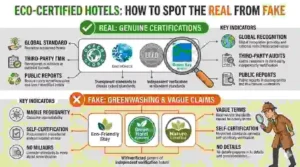
Vague Claims Without Proof
If a hotel says “We’re committed to sustainability” but doesn’t specify how, be suspicious.
Real eco-hotels will proudly display:
- Their certification number
- The certifying organisation’s name
- When they were certified
- Specific initiatives they’ve implemented
No details = no credibility.
Made-Up Certifications
This one’s cheeky. Some hotels create their own “certifications” and hope you won’t notice.
I once saw a hotel claiming to be “Green Earth Approved.” Sounds official, right? Except there’s no such certification body. They’d literally made it up.
Quick check: Google the certification name. If it doesn’t have an official website with clear standards, it’s fake.
Certification Logos Without Context
Anyone can copy a logo and stick it on their website. What matters is whether they’re actually certified.
Here’s what to do:
- Note the certification name
- Visit the certification body’s official website
- Look up the hotel in their directory
Most legitimate certification programs have searchable databases. If the hotel isn’t listed, you have your answer.
Focusing Only on Towel Reuse
Don’t get me wrong – reusing towels saves water. But if that’s the only green initiative a hotel mentions, it’s a bit thin.
That’s the absolute bare minimum. It’s like someone claiming to be a master chef because they can boil water.
Real eco-hotels will have multiple initiatives across different areas.
No Staff Training or Awareness
I always chat with hotel staff about their green initiatives. You’d be surprised what you learn.
At genuinely sustainable hotels, staff are knowledgeable and proud of their efforts. They’ll tell you about the solar panels, the composting system, and the partnership with local organic farms.
At greenwashing hotels? You get blank stares or generic responses that sound like they’re reading from a script.
How to Verify Eco-Certifications: Step-by-Step Guide
Let me walk you through exactly how I check hotels before booking.
Step 1: Check the Hotel’s Website
Look for:
- Specific certification names (not just “eco-certified”)
- Details about their sustainability practices
- Evidence like photos of solar panels, gardens, and recycling facilities
- Sustainability reports or policies (downloadable PDFs are a good sign)
Step 2: Visit the Certifier’s Website
Go to the official website of the certification body. For example:
- Green Key: greenkey. global
- LEED: usgbc.org/leed
- Green Globe: greenglobe.com
Step 3: Search Their Database
Most certification bodies have a “Find Certified Properties” search function.
Enter the hotel name and location. If it’s genuinely certified, it’ll appear. You’ll usually see:
- Certification level
- Date certified
- Validity period
- Sometimes,s even their audit scores
Step 4: Read Guest Reviews
Head to TripAdvisor, Google Reviews, or Booking.com. Search for terms like:
- “Eco-friendly”
- “Sustainable”
- “Green initiatives”
- “Recycling”
Real guests will mention if they noticed genuine eco-efforts. They’ll also call out greenwashing fast.
Step 5: Contact the Hotel Directly
Email or call them. Ask specific questions:
- “Can you provide your Green Key certification number?”
- “What percentage of your energy comes from renewable sources?”
- “Do you have a waste management policy I can review?”
Genuine hotels will happily provide details. Fake ones will give vague, uncomfortable answers.
Real vs Fake: Side-by-Side Comparison
Let me make this crystal clear with a comparison table.
| Aspect | Real Eco-Certified Hotel | Fake/Greenwashing Hotel |
|---|---|---|
| Certification DisplayShowa’s | a specific logo with a certification number | Generic green images or self-created badges |
| Verification | Listed in the official certifier’s database | Not found in any legitimate database |
| Details Provided | Specific data (e.g., “40% energy from solar”) | Vague claims (e.g., “We use renewable energy”) |
| Staff Knowledge | Well-trained, can explain initiatives | Unaware or provide scripted responses |
| Website Information | Dedicated sustainability page with reports | Brief mention in the “About Us” section |
| Guest Reviews | Guests mention specific green features | No mention of eco-initiatives in reviews |
| On-Property Evidence | Visible solar panels, gardens, recycling stations | Standard operation with token gestures |
| Auditing | Regular third-party audits | No external verification |
| Certifier Contact | Provides the certifier’s contact details willingly | Avoids providing verification details |
What Genuine Eco-Hotels Actually Do
Let’s talk about what real sustainability looks like in practice.
Energy Management
Solar panels and renewable energy: Many certified hotels generate their own power or purchase renewable energy credits.
Energy-efficient lighting: LED bulbs throughout the property, motion sensors in corridors.
Smart climate control: Room AC/heating that automatically adjusts or turns off when windows are open.
Water Conservation
Low-flow fixtures: Showerheads and taps that reduce water use without compromising your experience.
Rainwater harvesting: Collecting rainwater for gardens and toilet flushing.
Greywater recycling: Treating and reusing water from sinks and showers for non-potable purposes.
Native landscaping: Gardens designed with local plants that need minimal watering.
Waste Reduction
Comprehensive recycling: Separate bins for different materials, not just one “recycling” bin that goes to the landfill.
Composting: Food waste is turned into fertiliser for gardens.
No single-use plastics: Refillable bathroom amenities, glass water bottles, paper or metal straws.
Food waste programs: Partnerships with food banks, portion control, nose-to-tail cooking.
Community Engagement
Local employment: Prioritising hiring from nearby communities.
Local sourcing: Food and supplies purchased from local producers.
Cultural programs: Supporting local artisans and cultural preservation.
Education initiatives: Teaching guests and local communities about conservation.
My Personal Checklist (Feel Free to Steal It)
When I’m booking a hotel now, I run through this mental checklist. It’s never let me down.
Before Booking:
- Certification appears in the official database
- The hotel has a detailed sustainability page
- Recent guest reviews mention eco-initiatives
- Clear data provided (not just vague claims)
- Staff respond knowledgeably to email questions
Upon Arrival:
- Visible recycling bins in the room and common areas
- Refillable bathroom products (not tiny plastic bottles)
- Information cards about green initiatives
- Energy-saving features actually work
- Staff can explain the hotel’s sustainability efforts
During Stay:
- Noticed renewable energy sources
- Local products in the restaurant/shop
- Water conservation measures evident
- Waste separation facilities are available
- Green spaces well-maintained
If a hotel ticks at least 10 of these boxes, it’s probably legitimate.
Questions to Ask Hotels Before Booking
Don’t be shy about asking these questions. Any genuinely eco-certified hotel will welcome them.
About Certifications:
- “Which eco-certification do you hold, and what’s your certification number?”
- “When were you last audited, and by whom?”
- “Can I see your sustainability report?”
About Energy:
4. “What percentage of your energy comes from renewable sources?”
5. “Do you have solar panels or other on-site renewable energy generation?”
About Water:
6. “What water conservation measures do you have in place?”
7. “Do you use rainwater harvesting or greywater recycling?”
About Waste:
8. “What happens to waste from the hotel? Do you compost food waste?”
9. “Have you eliminated single-use plastics?”
About Community:
10. “Do you source food locally? What percentage?”
11. “How do you support the local community?”
Common Myths About Eco-Hotels
Let me bust some myths that might be holding you back.
Myth 1: Eco-hotels are always expensive
Not true. While some luxury eco-resorts cost a fortune, many certified hotels are mid-range or even budget-friendly. Sustainability isn’t about luxury; it’s about practices.
Myth 2: You have to sacrifice comfort
Rubbish. I’ve stayed in eco-certified five-star hotels with incredible amenities. Good environmental practices don’t mean rough sheets and cold showers.
Myth 3: All certifications are equally rigorous
Nope. Some certifications are much stricter than others. LEED Platinum and Green Key Gold are highly rigorous. Others might be easier to obtain.
Myth 4: Once certified, always eco-friendly
Wrong. Certifications expire and need renewal. A hotel certified five years ago might have let standards slip. Always check the certification date.
Myth 5: Small hotels can’t get certified
Actually, small independent hotels often lead the way in sustainability. They’re more agile and can implement changes faster than large chains.
What If You’ve Already Booked a Fake Eco-Hotel?
Alright, so you’ve done some digging and realised your booked hotel is greenwashing. What now?
Option 1: Cancel If Possible
Check the cancellation policy. If you can cancel without penalty (or with minimal cost), consider switching to a verified eco-hotel.
Option 2: Raise Your Concerns
Contact the hotel directly. Politely point out the misleading claims. Sometimes this leads to honest conversations and even policy changes.
Option 3: Leave Honest Reviews
After your stay, leave a balanced review mentioning the greenwashing. Help other travellers make informed choices.
Option 4: Report Serious Violations
If a hotel is blatantly using fake certification logos, you can report them to:
- The actual certification body they’re impersonating
- Consumer protection agencies in that country
- Travel booking platforms where they’re listed
The Future of Hotel Eco-Certification
Things are getting better, slowly but surely.
More countries are introducing regulations against greenwashing. The EU’s new Green Claims Directive will require companies to prove environmental claims with verified evidence.
Technology is helping too. Blockchain-based certification tracking is being tested, making it nearly impossible to fake credentials.
Consumer awareness is rising. Hotels know that travellers are getting smarter and are less likely to fall for vague green claims.
Final Thoughts
Look, I get it. Planning a trip should be exciting, not stressful. Having to verify every hotel’s eco-credentials adds extra work.
But here’s the thing – once you know what to look for, it becomes second nature. You’ll spot the real from the fake in minutes.
And honestly? It’s worth it. There’s something deeply satisfying about knowing your holiday isn’t contributing to environmental damage. Plus, genuinely sustainable hotels often provide richer experiences because they’re connected to their local environment and community.
Next time you’re booking accommodation, take those few extra minutes to verify. Check the certification database. Read the reviews. Ask questions.
Your planet (and your conscience) will thank you for it.
Safe travels, and remember – not all that’s green is gold, but the real stuff is absolutely worth finding.
links:-